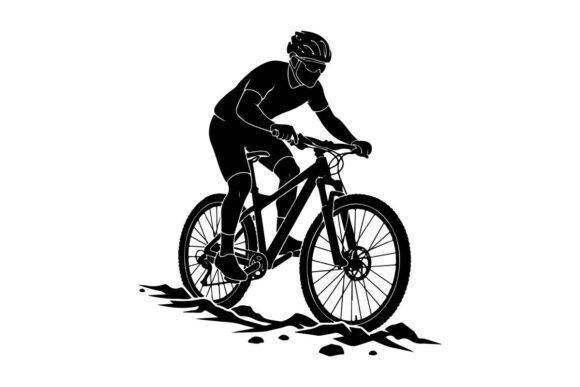
The Cyclist Riding Mountain Bike on Rough Terrain: A Visual Anchor for Modern Design
In the vast landscape of digital assets available to creators today, few images capture the essence of motion and resilience as effectively as a Cyclist Riding Mountain Bike on Rough Te. This specific imagery serves as more than just a decorative element; it is a powerful symbol of adventure, endurance, and the human spirit's connection to the natural world. When translated into high-quality vector formats, such as premium silhouette clip art, this subject matter becomes an indispensable tool for designers, marketers, and educators seeking to convey dynamic energy without visual clutter.
The appeal of the mountain biker traversing uneven ground lies in its inherent narrative. It tells a story of overcoming obstacles, navigating challenges, and finding freedom in the wild. For professionals working in branding, merchandise creation, or educational materials, leveraging this imagery allows for immediate emotional resonance with audiences who value outdoor activities and active lifestyles. The transition from a complex photograph to a clean, flexible silhouette strips away unnecessary distractions, leaving only the essential lines that define movement and form.
The Power of Silhouette in Contemporary Visual Communication
Silhouettes have long been a staple in graphic design, prized for their ability to communicate complex ideas through simplicity. When applied to the concept of a Cyclist Riding Mountain Bike on Rough Te, the silhouette style transforms a potentially chaotic scene into a streamlined icon. The rough terrain, which might otherwise require intricate texturing and shading to depict accurately, is reduced to bold, jagged shapes that suggest instability and challenge. Similarly, the cyclist is rendered not by facial features or clothing details, but by the posture of effort and the geometry of the bicycle.
This reductionism is where the true strength of the medium lies. By focusing on the outline, designers can ensure that the image remains legible at any scale. Whether the asset is used as a tiny favicon on a website or blown up to cover the side of a delivery truck, the clean edges and balanced shapes maintain their integrity. This scalability is a critical advantage in an era where content must perform across diverse platforms, from mobile screens to large-format prints. The modern silhouette style offers a timeless aesthetic that does not date quickly, ensuring that marketing campaigns and brand identities remain relevant even as design trends shift.
Visual Clarity and Brand Recognition
For business owners and marketing professionals, clarity is paramount. In a crowded digital marketplace, brands need visuals that can be recognized instantly. A detailed illustration of a mountain bike trail might take seconds for a viewer to process, whereas a stark, black silhouette of a rider conquering a steep incline registers immediately in the brain. This instant recognition helps in building brand recall. When a company consistently uses a specific visual motif—such as the rugged determination of a cyclist—it creates a cohesive visual language that customers begin to associate with the brand's values of strength and reliability.
Furthermore, the versatility of the silhouette allows it to blend effortlessly into various color schemes and backgrounds. Unlike photographic elements that might clash with a brand's palette, a monochromatic vector shape can be recolored to match any identity guide. This flexibility makes the Cyclist Riding Mountain Bike on Rough Te an ideal candidate for logo design, app icons, and social media graphics where consistency is key.
Technical Advantages of Vector-Based Clip Art
The technical foundation of these premium vector silhouettes is what separates them from standard raster images. Built using high-quality vector structures, these files are composed of mathematical paths rather than pixels. This distinction is crucial for anyone involved in professional design workflows. The optimized vector paths ensure smooth cutting, precise editing, and reliable performance across popular design software and cutting machines.
Consider the workflow of a creator producing custom merchandise. A t-shirt design featuring a mountain biker needs to be crisp enough to withstand repeated washing and durable enough to look professional when printed on fabric. Raster images often suffer from pixelation when scaled up, leading to blurry edges that detract from the final product. In contrast, a vector file maintains crisp detail and smooth edges at any size. From small decorative elements like stickers to large-format prints such as banners, the design can be scaled confidently while preserving professional-quality results.
Integration with Cutting Machines and Fabrication Tools
Beyond screen printing and digital publishing, the utility of vector silhouettes extends into physical fabrication. Hobbyists and small business owners utilizing vinyl cutters, laser engravers, or CNC machines rely heavily on clean, closed paths. The streamlined design of the Cyclist Riding Mountain Bike on Rough Te ensures that there are no stray points or open nodes that could cause errors during the cutting process. This reliability saves time and reduces material waste, making the production process more efficient and cost-effective.
The precision of the vector structure also allows for easy modification. If a designer needs to adjust the angle of the bike's wheels or alter the slope of the terrain to better fit a specific layout, they can do so directly within the vector software. This level of control is impossible with static images, giving creators the freedom to adapt the artwork to their unique needs without compromising quality.
Real-World Applications Across Industries
The adaptability of this specific imagery means it finds a home in a wide variety of industries. Its universal themes of action and nature make it suitable for applications ranging from corporate branding to educational resources.
- Sports and Outdoor Retail: Companies selling cycling gear, outdoor apparel, or adventure tourism services can use the silhouette to evoke the thrill of the sport. It serves as a perfect backdrop for promotional posters, event flyers, and packaging designs.
- Educational Materials: Teachers and curriculum developers can utilize the image to illustrate concepts related to physics (such as gravity and friction on rough surfaces), geography (terrain types), or health education (benefits of exercise). The clear lines make it easy for students to understand the mechanics of the movement depicted.
- Community and Non-Profit Organizations: Groups focused on environmental conservation or community fitness initiatives can leverage the imagery to promote events like charity rides or trail maintenance days. The visual suggests activity and engagement, encouraging participation.
- Digital Content Creation: Bloggers, YouTubers, and podcasters covering topics related to travel, fitness, or technology can use the silhouette as a thumbnail element or channel art. Its clean aesthetic stands out against busy video frames or blog layouts.
Creating Custom Merchandise and Branding Elements
One of the most popular uses for this type of clip art is in the creation of custom merchandise. The "clean and polished design structure" mentioned in the product description is particularly valuable here. When designing a line of water bottles, hats, or phone cases, the artwork needs to look intentional and professional. The silhouette of the Cyclist Riding Mountain Bike on Rough Te provides a strong focal point that commands attention without overwhelming the product.
Moreover, the ability to layer these vectors allows for creative depth. Designers can combine the silhouette with other elements, such as topographic maps, sunbursts, or typography, to create complex compositions that still retain a sense of order. This layering capability is essential for crafting unique branding elements that differentiate a business from its competitors.
Design Considerations for Effective Implementation
While the versatility of vector silhouettes is a significant asset, effective implementation requires thoughtful consideration. Simply placing an image on a page does not guarantee success; context matters. When integrating the Cyclist Riding Mountain Bike on Rough Te into a project, designers should consider the surrounding whitespace, the hierarchy of information, and the emotional tone they wish to convey.
For instance, the "rough terrain" aspect of the image implies struggle and effort. This makes it highly effective for motivational contexts or stories about overcoming adversity. However, if the goal is to portray relaxation or leisure, a different pose or setting might be more appropriate. Understanding the nuances of the imagery allows creators to align the visual with the intended message, ensuring that the design resonates with the target audience.
Additionally, the choice of color plays a vital role. While the base silhouette is often black, the power of vector art lies in its ability to be colored dynamically. Using gradients, textures, or brand-specific colors can transform the flat shape into something vibrant and engaging. For example, applying a sunset gradient behind the silhouette can enhance the feeling of adventure, while a solid corporate blue might emphasize professionalism and trust.
Accessibility and Inclusivity in Design
In today's design landscape, accessibility is a critical component. High-contrast silhouettes are inherently accessible, as they provide clear distinctions between foreground and background. This makes them easier to perceive for individuals with visual impairments compared to low-contrast or overly detailed illustrations. By choosing a clean, modern silhouette style, designers are inadvertently creating more inclusive content that reaches a broader audience.
Furthermore, the simplicity of the design ensures that the core message is not lost in translation across different cultures. The universal language of sports and nature transcends linguistic barriers, making the Cyclist Riding Mountain Bike on Rough Te a globally understood symbol. This universality is particularly valuable for international brands or organizations looking to expand their reach.
The Future of Minimalist Motion Graphics
As design trends continue to evolve, there is a growing appreciation for minimalism and functionality. The demand for assets that are both visually striking and technically robust is increasing. The Cyclist Riding Mountain Bike on Rough Te represents the intersection of these two worlds. It captures the complexity of motion and the ruggedness of nature within a simplified framework that is easy to use and modify.
Looking ahead, we can expect to see even greater integration of such vector assets in interactive media. With the rise of augmented reality (AR) and virtual reality (VR), clean vector shapes serve as excellent foundations for 3D modeling and animation. The clear outlines and defined forms make it easier to extrude, animate, and manipulate the image in digital environments, opening up new possibilities for immersive storytelling.
Ultimately, the value of this premium vector silhouette clip art lies in its ability to empower creators. It removes the technical barriers to entry, allowing professionals and hobbyists alike to focus on the creative aspects of their projects. Whether you are crafting a logo for a new startup, designing a poster for a local event, or producing educational content for a classroom, the Cyclist Riding Mountain Bike on Rough Te offers a reliable, versatile, and visually compelling solution that elevates the quality of your work.